
Belt & Chain Drive Repair in Boston & Greater Boston
Independent local contractors · Price explained before work starts · Boston and 61 nearby towns
Repairing or replacing stretched chains, frayed belts, worn trolleys, and bent rails.
At a glance Who does the work: an independent local contractor · Price: explained on site before work starts · Area: Boston and 61 nearby towns · How: the short form
Inside the service: belt and chain drive repair
The drive is what turns motor rotation into door movement. A chain drive uses a steel chain much like a bicycle's, strong and a bit noisy. A belt drive uses a reinforced rubber or polyurethane belt that runs quietly. Both pull a trolley along a rail, and both suffer when tension is wrong: too loose and the drive slaps the rail, too tight and it wears the sprocket and gear.
Typical work includes setting the tension to the maker's specification, replacing a belt with missing teeth or a chain with stiff links, and swapping a cracked trolley or a worn idler pulley at the far end of the rail. Sectional rails that have loosened at the joints are straightened and tightened. Screw-drive units are a separate case and mostly need the correct grease and a new coupler or carriage.
Why local knowledge matters around Boston
Around Boston, the same street can hold a century-old carriage house, a triple-decker with a shared driveway and a renovated home with a smart opener. Local contractors see all of it, which is why a request here goes to someone who works in your part of the metro area rather than to a distant call center.
Storms matter too. A nor'easter can take out power for hours, wind-driven rain finds worn seals, and plowed snow piled against a door adds weight and moisture where the cables and bottom section already have the hardest life.
Signs you need belt and chain drive repair in Greater Boston
If any of this sounds familiar, stop cycling the door and ask for a technician:
- The chain sags well below the rail when the door is closed
- A slapping sound as the door starts to move
- Cracks or missing teeth along the belt
- The trolley no longer latches after using the release
- Lights on the motor unit blink in a repeating pattern
- The wall button works but the remotes do not
The root causes behind belt and chain drive repair trouble
Openers wear in predictable places. Plastic drive gears shed teeth, chains stretch, belts fray, and the trolley that rides the rail cracks. Electronics age too: capacitors weaken, relays stick, and logic boards fail after years of heat and vibration. Quite often the opener is the victim instead of the culprit, worn down by a door whose springs stopped carrying their share of the weight.
Around Boston, storms account for a lot of opener calls. Power surges during nor'easters and summer thunderstorms can damage circuit boards and sensor wiring. Deep cold thickens the grease on the rail and stiffens the door, so the unit reads the extra resistance as an obstruction and reverses. Low winter sun shining into a photo-eye lens can also stop a door from closing.
Do this first: a homeowner checklist
- Stop using the doorLeave the door in its current position. Running a damaged door again can bend sections, strip the opener gear or drop the door.
- Keep people, pets and vehicles clearA door that is crooked, hanging or stuck partway can move without warning. Keep the opening and the area under the door clear until a technician has made it safe.
- Do not pull the red release cord with the door upThe red handle is for a door that is all the way down. Pulling it with the door raised and a broken spring can let the full weight fall.
- Note what you see and hearA ten-second look helps: a gap in the spring, a slack cable, a roller out of the track, blinking sensor lights, or a hum from the opener with no movement.
- Send a requestFill in the short form with the job, your town and a phone number. A local technician calls back, and you can ask about timing then.
What happens after you send a request
- Tell us what the door is doingJob type, your town, name, phone and ZIP code. It takes under a minute, and you only describe the problem once.
- The request goes to a local technicianAn independent garage door contractor covering Greater Boston receives the request. That contractor, not this site, does the work.
- You get a callbackThe technician calls to ask what the door is doing and to arrange a visit. That call is the moment to ask about timing.
- Options and price, before any workThe technician inspects the door, tells you what failed and why, and lays out the choices and the cost before touching a tool.
- You decideGo ahead, wait, or get a second opinion. Sending a request does not commit you to anything.
Timing and urgent situations
How soon a technician can come depends on the contractor's schedule that day, so we do not promise a time. Ask when they call. If a car is shut in, or the door is stuck open and the house is not secure, say that first so it can be handled as urgent.
What affects the price of belt and chain drive repair
There is no price list on this site, on purpose. The cost of belt and chain drive repair depends on the door in front of the technician, and a number invented online would be either wrong or bait. These are the things that actually move the quote:
- Which component failed: gear, board, motor, sensor, or drive
- Age and brand of the opener, and whether parts are still made
- Drive type: chain, belt, screw, or wall-mount
- Whether the door itself needs spring or roller work first
- Ceiling height and access to the motor unit
When you compare quotes, compare the same thing: the same parts grade and the whole job, not a low opening number with extras added later.
What is safe to do yourself, and what is not
Safe checks include confirming the outlet has power, replacing remote batteries, making sure the wall console lock button is off, and wiping and re-aiming the photo-eyes until both indicator lights are steady. You can also pull the release and try the door by hand. Do not open the motor housing while it is plugged in, and never bypass the safety sensors to get a door closed.
Door and opener brands
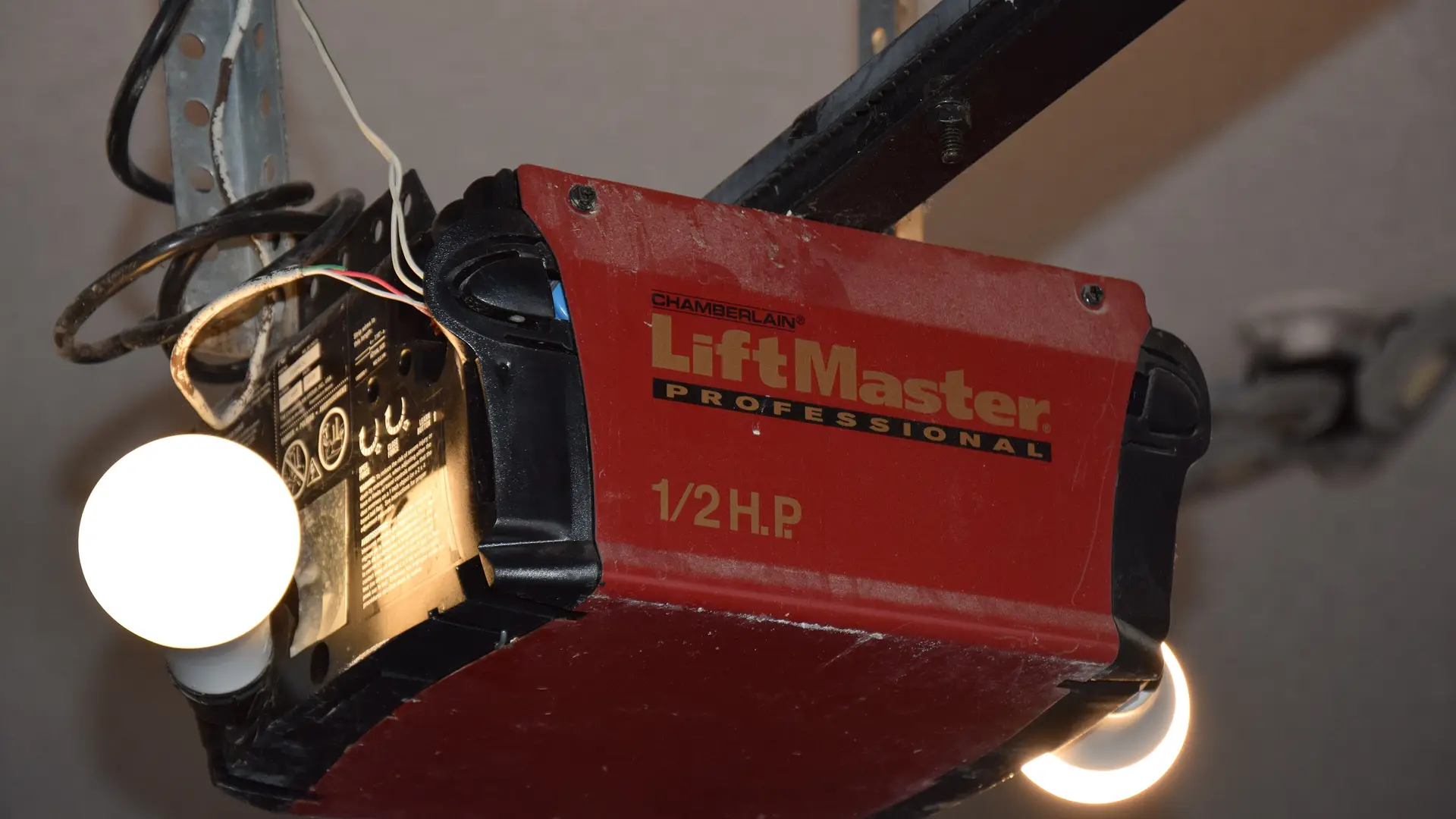
Independent contractors around Boston commonly work on the opener and door brands found in local garages, including Marantec, CHI Overhead Doors, LiftMaster, Chamberlain, Genie and Craftsman. If you can see a name on the opener or on the inside of the door, mention it in your request. Boston Garage Door is not affiliated with any manufacturer.
Care that fits a New England garage
- Test the safety reversal monthly by closing the door on a flat piece of lumber.
- Plug the opener into a surge protector to shield the board during storm season.
- Keep the door balanced and its rollers oiled so the motor is never overworked.
- Wipe the photo-eye lenses and check their brackets whenever you sweep the garage floor.
Coverage across Greater Boston
Requests are taken for Boston and 61 nearby cities and towns in Suffolk, Middlesex, Norfolk, Essex and Plymouth counties. Pick your town:
Middlesex County
Norfolk County
How Boston Garage Door works
- Repair and replace, both on the tableAsk the technician to lay out the repair and the replacement side by side when a door is near the end of its life.
- A referral service, said plainlyBoston Garage Door connects homeowners with independent local garage door contractors. It is not the company that does the repair.
- One short requestJob type, town, name, phone and ZIP code. No calling around, no long questionnaire.
- Local, independent contractorsThe request goes to a contractor who works in Greater Boston, not to a national call center.
- The price is explained firstThe technician looks at the door and explains the options and the price before any work starts.
- No invented pricesYou will not find a made-up price list or a teaser rate here. The contractor quotes after seeing the door.
Explore related services and areas
Looking for something more specific? These pages cover the services and communities people ask about most:
- Garage Door Opener Repair
- Opener Gear Replacement
- Opener Circuit Board Replacement
- Travel Limit & Force Adjustment
- Wall Button & Wiring Repair
- Garage Door Opener Repair in Boston
- Garage Door Opener Repair in Cambridge
- Garage Door Opener Repair in Somerville
- Garage Door Opener Repair in Brookline
- Garage Door Opener Repair in Newton
Garage door terms worth knowing
- Cycle rating
- How many open-and-close cycles a spring is built for. Standard springs are commonly rated around 10,000 cycles.
- R-value
- A measure of how well an insulated door resists heat flow. Higher numbers insulate more.
- Astragal
- Another name for the flexible seal along the bottom edge of the door.
- Torsion spring
- A tightly wound spring on a shaft above the door. It twists to store the energy that lifts the door's weight.
- Extension spring
- A long spring beside each horizontal track that stretches as the door closes. It should always have a safety cable through it.
- Lift cable
- The steel cable on each side that connects the bottom of the door to the drum and carries its weight.
Get belt and chain drive repair in Greater Boston moving
One request, one callback. The technician explains what the door needs and what it costs, and you decide.
Frequently asked questions
How tight should an opener chain be?
Slightly slack. Most makers call for the chain to sit a small distance above the rail at its midpoint, not pulled taut. Over-tightening is a common mistake that wears the sprocket and gear. The manual for your model gives the exact figure.
Is a belt drive quieter than a chain drive?
Generally, yes. A belt has no metal-on-metal contact along the rail, so there is less rattle carried into the house. Much of what people hear, though, comes from the door's rollers and hinges, so those matter just as much.
What affects the price of an opener repair?
Mainly the part involved and the model. Sensors and gears are smaller jobs than boards or motors, and parts for discontinued units can be harder to find. The contractor diagnoses the opener first and gives you repair and replacement options to compare.
Can I use the door while the opener is broken?
Usually. Pull the red release handle with the door closed, then lift and lower it by hand. This only works safely if the springs are intact and the door is balanced. Remember that a released door is not locked by the opener.
Should I repair my opener or replace it?
It depends on the unit's age, the part that failed, and whether parts are still made. A gear or sensor on a sound opener is usually worth fixing. Units built before photo-eyes became standard in the early 1990s are generally replaced for safety reasons.
Is this the company that does the work?
Boston Garage Door is a service that connects homeowners with local contractors. The work itself is done by the independent garage door contractor who takes your request.
Do you give prices online?
No. The cost depends on the door, the parts involved and what the technician finds, so the contractor quotes after looking at it and explains the price before any work starts.
What should I have ready when the technician calls?
What the door is doing, any sounds it made, whether it is up, down or stuck partway, the opener brand if you can see it, and your town and ZIP code.
I rent. Can I send a request?
Yes, but repairs to the building are normally the owner's decision. It is usually simplest to tell your landlord or property manager first.
Do contractors work on older or discontinued doors?
Many do. Older garages around Boston are full of doors and openers that are no longer made. Describe what you have, and the technician will say whether parts can still be found.